Tuesday, January 2

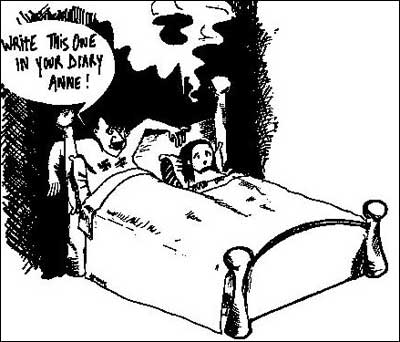
Iran: Hitler was a Jew (and Genghis Khan was really 'Kohen')


Spot the difference.
As I've often told friends and colleagues: There's no point in parodying news from the Middle East, since reality is so far ahead of the curve.

From Ynet News:

A top advisor to Iranian President Mahmoud Ahmadinejad claimed in an interview with Iranian website Baztab that Nazi leader Adolf Hitler's parents were both Jewish and that Hitler himself was one of the founders of the State of Israel.

In the interview, translated by MEMRI (Middle East Media Research Institute) Mohammad-Ali Ramin, a chief aide to Ahmadinejad, told Baztab that Hitler's paternal grandmother was a Jewish prostitute and his father even kept his Jewish name until finally changing it to Hitler when he was 40.


Go here for more Ahmadine-laffs.

Monday, January 1

Iran: Israel and the Endgame

If you were a Jew in Europe in 1941, and you actually knew that Hitler was developing the means to carry out his threat to exterminate the Jews, what would you do? Dismiss the danger as overstated? Try to arouse the nations of the world to stop him? Or take upon yourself to employ every means possible -- both physically and spiritually -- to avert the catastrophe?

If you are a Jew in 2007, and you actually know that Ahmadinejad is developing the means to carry out his threat to exterminate the Jews of Israel, what will you do?

No hype. A must read.

A personal plea. For your children's sake.

It was a sad, but simple event. Or so it seemed. Here's the report I called in to The Jerusalem Post Internet desk:
Jan. 1, 2007 9:44 | Updated Jan. 10,:50
Man seriously injured after hit by car in J'lem
By DAVE BENDER

A pedestrian was seriously injured after being hit by a van on Derech Hebron in Jerusalem Monday morning. The man, apparently an Arab in his mid-20s, was struck at the intersection near the Talpiot industrial area shortly after 9 a.m.
Bystanders administered first aid on the scene until a Border Police team arrived, along with an ambulance.
Police were still questioning the driver of the van after the victim was evacuated to Jerusalem's Hadassah Ein Karem hospital.
No war or terrorism, no other casualties. Just another scrolling Internet headline that could have been written about a traffic accident anywhere in the world Or was it?

The difference, for me, was that I crossed the intersection, heading towards the shopping district scant moments after the accident took place:

As I waited for the crosswalk light to turn green, I heard a car horn suddenly blare, and then glanced down near the curb, across the intersection in the southbound lane. I saw what, at first glance, appeared to be a pile of old clothes lying in the street.

It's bitterly funny sometimes, how the mind refuses to accept what the eyes clearly see.

After a few seconds I noticed a head and arms in the crumpled mass, and then disconnectedly realized that I was looking at the broken, unmoving body of a young man, a rivulet of blood from his right ear joining a more copious flow from beneath his head on the pavement. The ripped left leg of his work-stained jeans exposed what appeared to be a broken thigh, with both knees and ankles folded at unnatural angles. His cap and what looked like a wallet were thrown a few meters to the side; his shattered cellphone was lying under his right foot, equally shattered.

That's what the brief called "seriously injured." I though you should understand what those two words, "seriously injured," can really represent in a news brief.

Two male passersby were beside the casualty, one gently patting his shoulder and quietly talking with him, in an effort, perhaps, to keep him conscious, as the second spoke into his cellphone, summoning an ambulance. They didn't move him from the street where he lay, afraid they might cause even greater injury.

As I waved down the oncoming traffic, two transit buses, like the one that hit the pedestrian, edged by slowly, cautiously, on their way to nearby Bethlehem.

Bus passengers at the nearby stop averted their eyes, as others covered their mouths in horrified dismay. A man held tight to a stunned, trembling woman on the traffic island, who, on the verge of tears, kept repeating, “I saw it all...” Close by, the driver of a sedan rigidly stood outside her vehicle, refusing assistance, as she tightly clutched the door's window frame, watching the scene unfold with tears running down her face.

A short time later, I again passed through the intersection, this time on a bus, and looked out at the accident scene as we turned the corner where the collision took place. The ambulance had evacuated the victim, and I saw police investigators talking with the van's driver. Vehicles carefully eased past, as a few rubberneckers watched from the sidewalk. The cap and wallet were gone, but the pool of blood remained.

Hebron Road, along with several other major streets and thoroughfares in the capital has seen it's share of such accidents. Many are due to the changes in traffic patterns as the route for the city's light rail system is installed; one morning, one-way streets become two-way, and roads and sidewalks are regularly ripped open, and pedestrians dare speeding buses, dump trucks and taxis as to who can cross the intersection faster. There is only one footbridge over the busy road, located a few hundred meters to the south. It connects a school with the Arnona neighborhood.

Hebron Road is also a major traffic artery running from Bethlehem and Gilo in the south, to the city center in the north, and at midmorning resembles a racetrack straightaway more than a street with traffic lights and crosswalks. Although several kilometers of new fencing keeps people from cutting across between intersections, the traffic islands themselves are often crowded with children, women with strollers, and people carrying shopping bags, all waiting for the lights to change. The gusts from vehicles cannonballing by, only what feels like scant centimeters away, is intimidating.

The victim could have been anyone's son, brother, uncle or friend. He looked to me like any of the young Israeli Arabs or Palestinians that throng the auto-repair garages, shops and restaurants nearby. Just someone rushing by, hurrying to get to work, but at the wrongest instant.

As 2007 begins, consider the above as a personal plea from me to you to resolve to drive more carefully, and more aware. ”V'shamartam meod l'nafshotechem” - “Guard yourself and guard your soul very much" (Deuteronomy 4:9) isn't just a Biblical piety.

It means slow down.

It means ease your foot off the gas pedal.

It means watch your kids as they cross the street, and teach them to look both ways twice. At the very least.


"S'h'lo nid'a od da'ava." "May we know no more sorrow."

For more: Metuna.

Urgent Appeal: In Israel? Give Blood, Overseas? Donate


From Haaretz:

The Blood Bank at Magen David Adom on Monday stopped delivering blood supply to hospitals, save for urgent and life-saving surgeries, due to a severe shortage in blood reserves.

The Blood Bank has a mere 400 O-type blood units, reserves that are not sufficient for a single day.

Having read this report, I plan to donate tomorrow, and will try to post a podcast and photo report from the scene.

So how 'bout you? Roll up your sleeves, people; pull out the credit card and go here.

You know you want to.

(H-T: Jewschool)

Top 10 M.E. Conspiracy Theories of 2006 (betcha' can't guess who's behind them all...)

MEMRI's Steven Stalinsky, writing in the New York Sun, takes a look at the 10 most pervasive conspiracy theories plaguing the Middle East.

C'mon, bunky; I just double dare you to guess who's behind all the troubles afflicting the Arab world. And, no, it's not the Amish. Similar sartorial tastes, though...

A Saudi journalist, Mshari Al-Zaydi, wrote about the "disease" of the Arab press blaming others for the Arab world's misfortunes in a London-based newspaper, Al-Sharq Al-Awsat, on November 20. "This huge obsession among some Arabs and Muslims regarding conspiracy theories and the belief that the world is lurking in wait to pounce on us, as if the world has no worries other than cooking up plans, policies, and moves in order to realize one objective only: to eliminate Islam, Muslims, and Arabs," Mr. Al-Zaydi wrote.

G'wan and read the list before Letterman does.

Web Site of the Arab European League (February 2, 2006)

Sunday, December 31

Washington PostGlobal end-of-2006: readers' fave proverb or saying


Replying to a Washington PostPostGlobal 2006-year-end query:

What is your favorite proverb or saying from where you live that you would want to share with the world? What does your proverb tell us about today?

I responded:

"We survived Pharaoh? We'll survive this, too..." goes the refrain of a popular song released many years ago by veteran Israeli pop-rocker, Ariel Zilber.

Casting a wry and darkly acerbic, yet wearily hopeful eye at personal and national predicaments, the tune tallies a litany of woe, each stanza ending with the tag line reminding the listener that a bit of historical perspective in facing crises is a useful trait.

The song incorporates a traditional Jewish attitude, memorialized in the Passover Seder, of sensible gumption and looking beyond the present peril to better times ahead. And not a moment too soon, taking a quick look up-thread at some of the obnoxious, mean-spirited replies slamming Jews ("Neocons" in WaPo PC-speak) and Israel in what was - clearly - to have been a pleasant, end-of-year multiculti "contrast and compare." Sheesh. Get. a. life. you losers...

And to the rest of the WaPo bloggerati: a healthy and successful 2007 to you and yours.

Israel: This Little Piggie Went to Heal...

"Jews and pigs? What, like, together? Isn't that, umm, un-kosher?"

Well, not really. Turns out that a "team from the Weizmann Institute of Science have demonstrated for the first time how tissues transplanted from pig embryos might, in the future, be able to induce the human body to produce blood-clotting proteins for hemophilia patients and other critical substances."

Read the rest here. More on Jewish views of this issue are here, here and here.

Sure beats going Islamic over anything porcine...

Israeli and Palestinian reactions to Saddam execution


From Haaretz:

In the wake of the execution of former Iraqi dictator Saddam Hussein, Deputy Defense Minister Ephraim Sneh on Saturday expressed his concerns about Iraq's path in the post-Saddam era.

Sneh told Israel Radio that Israel was concerned about the strengthening of Iranian influence in the Shiite sections of southern Iraq and also in the central government. Iraq had also become a regional "power station" for terror that could spread chaos throughout the Middle East, he said.

"We have to be worried about what is going to happen now," he said.
From Ynet News:
PA residents reminisced over the Gulf War, when dozens of Scud missiles were launched at Israel . The missiles, which landed in the center of the country in 1991, were accompanied by celebrations and chants: "Saddam, strike Tel Aviv."

The Iraqi president remained popular among the Palestinians also during the recent intifada, when he promised to transfer USD 25,000 to families of Palestinians killed in terror attacks and clashes with Israel.

From The Jerusalem Post:

He further endeared himself to the Palestinians during the recent uprising with Israel by giving US$25,000 to the family of each suicide bomber and US$10,000 for each Palestinian killed in fighting. The stipends amounted to an estimated US$35 million.

Day By Day: Saddam

Thursday, December 28

You mean, that - that's it?...


The morning after...

...the night before.
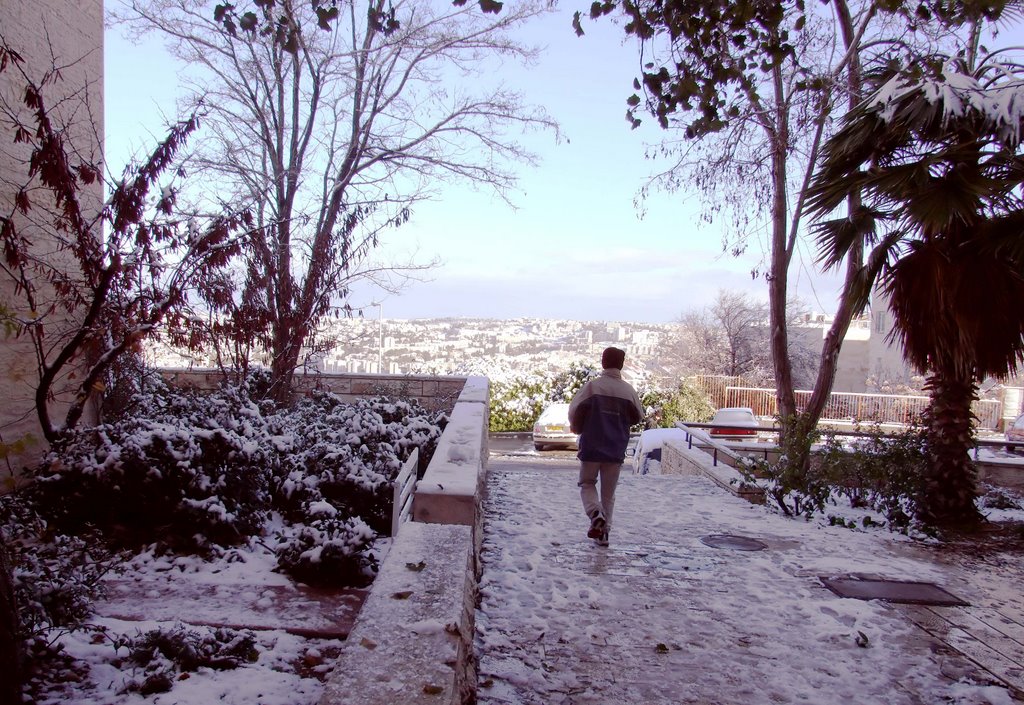
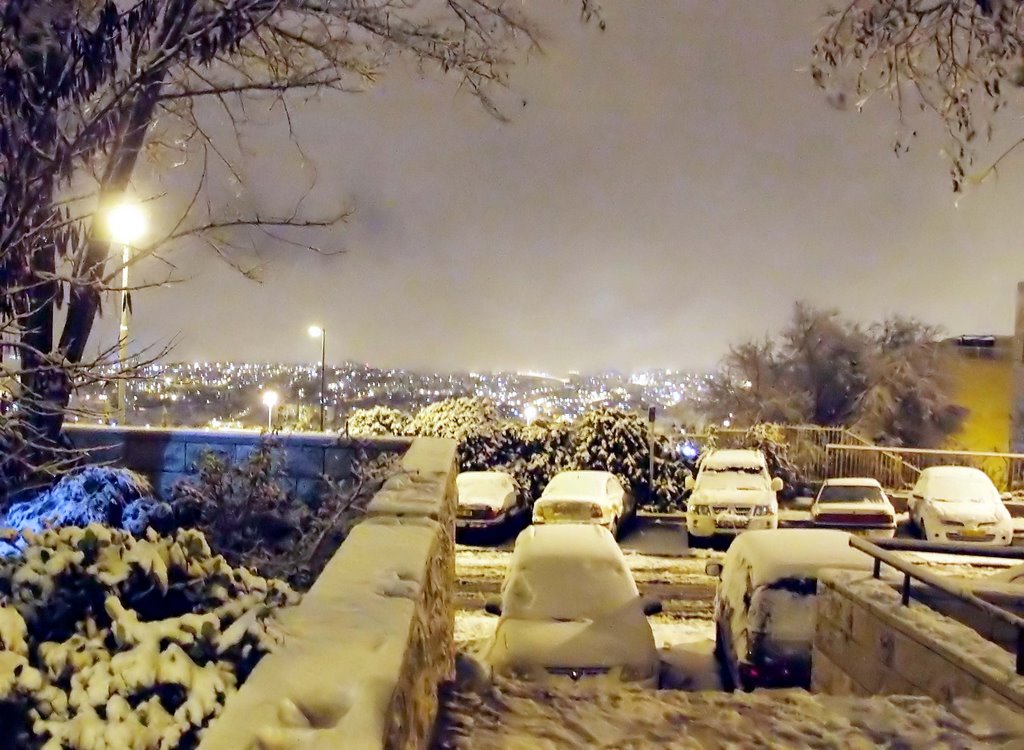
Well, even though it took me almost an hour's-and-a-half on a jam-packed bus ride from downtown Jerusalem to make a 20-minute journey home to Gilo yesterday afternoon, it was nice to crunch around the neighborhood to get a few shots for posterity...


More at the JPost of the storm's ravages countrywide.

Search:

Google
Web Israel At Level Ground