
Southern Israel: Like bomb shelters with revolving doors
(I penned this comprehensive feature in early 2012 during a day-long visit to cities and towns adjacent to the border with the Gaza Strip in the wake of yet another series of terrorist-launched rocket salvos on Israeli cities, towns and villages in a 40-kilometer radius of the coastal enclave.
(I penned this comprehensive feature in early 2012 during a day-long visit to cities and towns adjacent to the border with the Gaza Strip in the wake of yet another series of terrorist-launched rocket salvos on Israeli cities, towns and villages in a 40-kilometer radius of the coastal enclave.
Due to the significant differences in the version that was eventually published elsewhere, I'm reproducing the original here in light of the near-constant steel rain on southern Israel since then, including two to three rockets on Sunday, Aug. 26th, which slammed into two factories in Sderot.
If you choose to reproduce this, I ask that you use it all, without additions, and with my full name and website: http://www.davidbrianbender.com. Thanks, DB)
Southern Israel: Like bomb shelters with revolving doors
 |
| Two school boys, residents of Kibbutz Nir Oz near the Gaza Strip, examine pockmarks on a kindergarten's reinforced security wall from a Kassam rocket attack against their small farming community. (Photo: Dave Bender: All Rights Reserved) |
by Dave Bender
One of three Grad rockets fired by Gaza militants at Beersheba Wednesday evening evaded the Israeli army's Iron Dome anti-missile system, wounding one resident and sending 20 others into traumatic shock. The other two were downed in open areas outside the city.
Air Force craft later hit a rocket launching pad in northern Gaza, and an arms smuggling tunnel in the south, the army said, confirming direct hits. There were no reports of Palestinian casualties.
Air Force craft later hit a rocket launching pad in northern Gaza, and an arms smuggling tunnel in the south, the army said, confirming direct hits. There were no reports of Palestinian casualties.
Despite attempts by Israelis within a 40 kilometers radius of the Gaza Strip to return to the “new normal,” rocket attacks since Tuesday's informal Egyptian-brokered “cease fire” between Israel and Palestinian militants left many wondering just when the first half of the term “cease fire” would actually begin.
Seven mortars hit coastal Ashkelon and Ashdod that morning, and a Grad-model Katyusha slammed down in Netivot, east of the coastal enclave, the same night.
By Wednesday evening, officials in the three cities rescinded an announcement a day earlier for close to 200,000 students to return to school, closed since Sunday.
An editorial cartoon in the morning's Maariv Hebrew daily may have summed up dizzying violence best: A family is seen exiting a building's revolving door, above which a sign reads: “Protected Space” – a bomb shelter.
Assessing both internal and external damage
One Beersheba resident I spoke with on Monday was so distressed over the 200-plus rockets fired into her city since last Friday, that she broke into tears just enumerating her experiences.
“What I feel right now is just totally, totally drained,” Barbara Carter said after Wednesday's salvo.
“We were eating pizza when the siren sounded, and when we came back upstairs (from taking shelter on a lower floor of her apartment building) I said I felt like I was going to throw up,” said Carter, who is a retired American immigrant.
“I'm very discouraged and disappointed that our government isn't doing something; but at the same time I understand the ramifications of going into Gaza,” she said of a possible ground foray to halt the rocket fire made by army southern Command chief, Maj.-Gen. Tal Russo.
"There is no magic solution to the rocket fire from Gaza,” Russo said, noting that, “There might be situations in which we would need to launch a larger operation,” according to the Ynet news site.
Reporters visiting the region Wednesday saw glaziers replacing blown out shop windows from Grad strikes just days earlier, heard city officials describe near-90 percent drops in business revenues since last Friday, and toured rocket-pockmarked kibbutz kindergartens with shrapnel-holed inch-thick security glass windows.
 |
| Distances and time needed to reach safety when a rocket from Gaza is fired into southern Israel (Courtesy). |
Guns versus butter
In a board room at Ashkelon's city hall complex, Mayor Benny Vaknin sits before a PowerPoint slide showing dotted locations of every rocket hit across his city over the last few years. The map looks like it contracted the measles. He offers a thumbnail overview of the steel rain's economic storm on the city's 120,000 residents.
“For the last four days – I don't have the exact [figures] … almost 20, 25 percent of the people didn't go to their factories. This morning I had meetings with all of the heads of the commercial shopping centers … they told me that all the revenue – their income – decreased maybe 80 – 85, maybe 90 percent,” Vaknin said.
Smaller “mom and pop” shops were especially hard hit by the sharp drop in walk-in customers.
“We have here hundreds of small businesses; from what they sell, they eat. A lot of small businesses, small shops, they don't have a reserve,” he says, recalling a similar situation during the month-long Operation Cast Lead in Dec. 2008, “when hundreds of families were in a very poor situation,” and businesses saw, “tens of millions” in losses.
Vaknin says the uncertainty over where the next volley of rockets will hit makes “people prefer to stay home; they are afraid. You know, in October – in the previous cycle of violence – a man in Ashkelon was killed. [Moshe Ami] was very famous culturally.”As well, “Tens of people were wounded; they were outside, so most of the people [now] prefer to stay home.”
But, despite the glum present, Vaknin remains undaunted and recalls agreements reached with Gaza City officials in the 1990s for mutual municipal infrastructure, and distance-learning projects.
On a trip with Gaza's mayor to the United States and Germany to raise matching funds for both cities, “We succeeded to collect one million dollars in donations from former Israeli Jews in the U.S., and started a youth-training project for Gaza and for Ashkelon.”
He says still holds out hope that such goodwill will not remain a tattered memory.
“'I don't despair,'” he told me, 'because I believe that this way, we can prepare the people for peace.'”
Dr. Alan Marcus, Ashkelon's Director of Strategic Planning agrees, despite the complexities of the present “fire-cease-fire” reality between Israel, and Gaza militants.
“The minute the feeling is that it is more important to do better for your own people, instead of killing the other side – whether you have a formal peace or not – we can do great things for both sides,” Marcus told me after Vaknin's presentation.

Remains of detonated Kassam rocket, Sderot police station .
(Photo: Dave Bender: All Rights Reserved)
Israeli hospitals: healing both sides
Not far from Vaknin's office, Naomi Maximov, a religious woman in her late 60s sits in her room at the city's Barzilai Hospital.
She says dozens of missile alerts since last week alone have left her traumatized, and points to a heavily bandaged leg.
Her apartment building doesn't have a bomb shelter, so when there are missile warning sirens she and neighbors take refuge in the stairwell – the innermost and safest place in the structure. But during one alert, she tripped and fell running for cover, causing her injury and hospitalization.
“I am afraid – terrified,” she tells me.
"Even at the hospital?" I ask.
“Absolutely,” she insists, “I'm going to another hospital for rehabilitation, and if they don't provide me with a 'safe' room, otherwise I won't sleep there.”
Maximov, who covers her hair out of religious modesty, says that “Every night – and I mean EVERY night, I prepare a nightgown, a hair covering, slippers, and then get into bed. The moment there's a siren, I run...”
Her broken hip may heal sooner than her Post Traumatic Stress Disorder, brought on by the around-the-clock sirens and explosions.
“I'm always stressed breathless – 'what will be, what will be, what will be?' – I'm always tense,” she says.
Meanwhile, several floors above, Muhammad Abudana tends to his wife, Kamla, a cancer patient in her forties who was hospitalized at Barzilai 16 days ago. The two are from Khan Yunis in southern Gaza.
Muhammad requested that Kamla be operated on in Israel rather than at a Gaza hospital. Authorities on both sides agreed, and the two traveled to Barzilai for her treatment.
As a humanitarian gesture, Israel annually accepts thousands of Gazan and West Bank Palestinians for medical treatment at no cost at hospitals throughout the country.
Muhammad says the last few days of fighting between Israel and the Palestinians was very difficult for him, especially when he had to run for shelter with everyone else during missile attacks on the city.
Ironically, because of those very missile attacks, the hospital is currently building a massive150 million dollar, 350 bed underground facility. The facility's four surgical floors will hold ten operating rooms and a 50-bed, mass-casualty emergency ward.
Coffee, Kassams, and kindergartens
Carol Simantov is the nurse at 300-member Kibbutz Nir Oz, next to southern Gaza. The community's stuccoed one-story homes and schools sit less than three kilometers (under two miles) from the heavily-guarded border fence, it's verdant fields lay even closer.
Missile have been slamming down by them for a decade, and Carol says one member lost both legs in a rocket attack, and a second died of wounds.
Standing in front of a pockmarked outer walls of one of the village's kindergartens, she points to where shrapnel from a nearby Kassam hit one morning a few days ago. Several steel shards ricocheted straight through an armored glass window, and sliced through the ceiling tiles – shortly before the mothers and children arrived.
Across a footpath a few children play on a swing hung from branches of a tree that faces the kindergarten. Fist-sized shrapnel gouged deep into the trunk and roots, and on the walls of a home a few meters away.
What do you do when a rocket lands?
Standing in front of a pockmarked outer walls of one of the village's kindergartens, she points to where shrapnel from a nearby Kassam hit one morning a few days ago. Several steel shards ricocheted straight through an armored glass window, and sliced through the ceiling tiles – shortly before the mothers and children arrived.
Across a footpath a few children play on a swing hung from branches of a tree that faces the kindergarten. Fist-sized shrapnel gouged deep into the trunk and roots, and on the walls of a home a few meters away.
What do you do when a rocket lands?
“What do we do?” she answers with a sigh, “... now that most of us have home shelters, it's not as frightening as if it was a war.”
But, she continues, “If you're out on the streets, it's very difficult because you have about ten seconds from the siren – it kind of screams at us 'Color Red! Color Red!' – and that's our code warning. If we're close enough, we have spread out through the kibbutz oversize sewer pipes that we can hide in. We have bomb shelters for 'normal life,' – [but] there's no normal here anymore.”
Simantov, who immigrated from Pennsylvania several decades ago, recounts a pastoral, yet jarring image she shares with friends back in the U.S.
“...I sit on my patio on a summer evening having my coffee, and listen to the sounds of war in the background,” she says, laconically.
But
while she admits that life alongside a war zone certainly “isn't
easy,” Simantov says she has no plans for pulling up stakes for
quieter areas further away from the front.
“...they don't understand why I'm here,” she says of worried family and friends abroad.
“They keep saying, 'when are you coming home?' and I say 'I've been here for 38 years already – so sometime you have to accept that this is home."
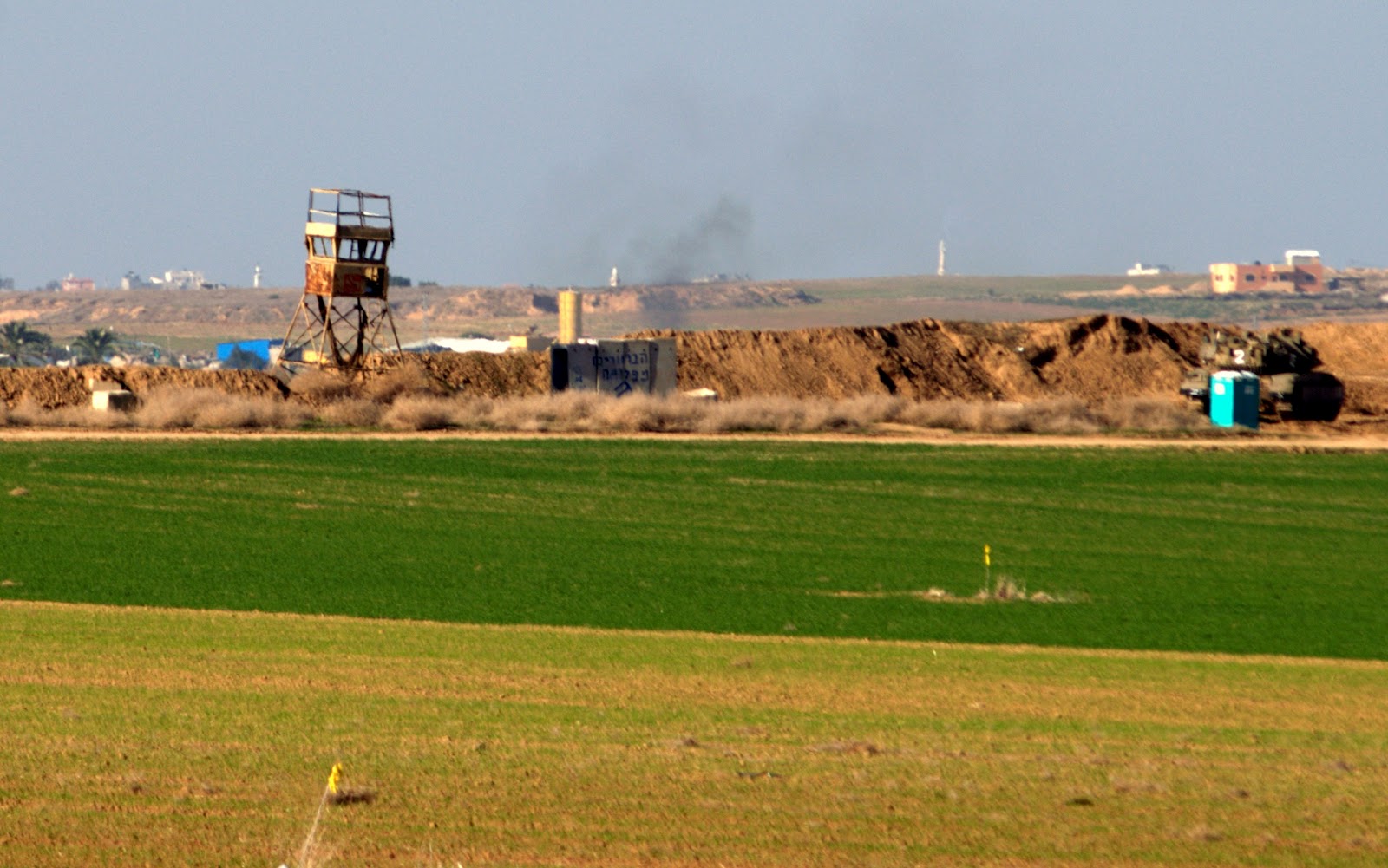
An Israeli army tank, a porta-potty, and an unused lookout tower at a position facing the Gaza Strip across the road from a kibbutz, whose fields are seen in the lower part of the image (Photo: Dave Bender, All Rights Reserved)
 |
| Israeli army display of military-grade and homemade IED's used against troops and civilians along roads and patrol paths adjacent to the Gaza Strip (Photo: Dave Bender: All Rights Reserved) |


