Showing posts with label terror attacks. Show all posts

Sunday, August 26

Southern Israel: like bomb shelters with revolving doors


Southern Israel: Like bomb shelters with revolving doors
(I penned this comprehensive feature in early 2012 during a day-long visit to cities and towns adjacent to the border with the Gaza Strip in the wake of yet another series of terrorist-launched rocket salvos on Israeli cities, towns and villages in a 40-kilometer radius of the coastal enclave. 


Due to the significant differences in the version that was eventually published elsewhere, I'm reproducing the original here in light of the near-constant steel rain on southern Israel since then, including two to three rockets on Sunday, Aug. 26th, which slammed into two factories in Sderot.

If you choose to reproduce this, I ask that you use it all, without additions, and with my full name and website: http://www.davidbrianbender.com. Thanks, DB) 

---

Southern Israel: Like bomb shelters with revolving doors


Two school boys, residents of Kibbutz Nir Oz near the Gaza Strip, examine pockmarks on a kindergarten's reinforced security wall from a Kassam rocket attack against their small farming community.
(Photo: Dave Bender: All Rights Reserved) 
Southern Israel: life in bomb shelters with revolving doors

by Dave Bender
One of three Grad rockets fired by Gaza militants at Beersheba Wednesday evening evaded the Israeli army's Iron Dome anti-missile system, wounding one resident and sending 20 others into traumatic shock. The other two were downed in open areas outside the city.

Air Force craft later hit a rocket launching pad in northern Gaza, and an arms smuggling tunnel in the south, the army said, confirming direct hits. There were no reports of Palestinian casualties.

Despite attempts by Israelis within a 40 kilometers radius of the Gaza Strip to return to the “new normal,” rocket attacks since Tuesday's informal Egyptian-brokered “cease fire” between Israel and Palestinian militants left many wondering just when the first half of the term “cease fire” would actually begin.

Seven mortars hit coastal Ashkelon and Ashdod that morning, and a Grad-model Katyusha slammed down in Netivot, east of the coastal enclave, the same night.

By Wednesday evening, officials in the three cities rescinded an announcement a day earlier for close to 200,000 students to return to school, closed since Sunday.

An editorial cartoon in the morning's Maariv Hebrew daily may have summed up dizzying violence best: A family is seen exiting a building's revolving door, above which a sign reads: “Protected Space” – a bomb shelter.

Assessing both internal and external damage

One Beersheba resident I spoke with on Monday was so distressed over the 200-plus rockets fired into her city since last Friday, that she broke into tears just enumerating her experiences.
What I feel right now is just totally, totally drained,” Barbara Carter said after Wednesday's salvo.
We were eating pizza when the siren sounded, and when we came back upstairs (from taking shelter on a lower floor of her apartment building) I said I felt like I was going to throw up,” said Carter, who is a retired American immigrant.
I'm very discouraged and disappointed that our government isn't doing something; but at the same time I understand the ramifications of going into Gaza,” she said of a possible ground foray to halt the rocket fire made by army southern Command chief, Maj.-Gen. Tal Russo.
"There is no magic solution to the rocket fire from Gaza,” Russo said, noting that, “There might be situations in which we would need to launch a larger operation,” according to the Ynet news site.
Reporters visiting the region Wednesday saw glaziers replacing blown out shop windows from Grad strikes just days earlier, heard city officials describe near-90 percent drops in business revenues since last Friday, and toured rocket-pockmarked kibbutz kindergartens with shrapnel-holed inch-thick security glass windows.

Distances and time needed to reach safety when a rocket from Gaza is fired into southern Israel (Courtesy).
The current round of violence began on Friday when Israeli Air Force craft struck and killed a senior operative of the Palestinian Popular Resistance Committees, preempting a major terrorist attack along the Israeli-Egyptian border, the army said.

Guns versus butter

In a board room at Ashkelon's city hall complex, Mayor Benny Vaknin sits before a PowerPoint slide showing dotted locations of every rocket hit across his city over the last few years. The map looks like it contracted the measles. He offers a thumbnail overview of the steel rain's economic storm on the city's 120,000 residents.
For the last four days – I don't have the exact [figures] … almost 20, 25 percent of the people didn't go to their factories. This morning I had meetings with all of the heads of the commercial shopping centers … they told me that all the revenue – their income – decreased maybe 80 – 85, maybe 90 percent,” Vaknin said.
Smaller “mom and pop” shops were especially hard hit by the sharp drop in walk-in customers.
We have here hundreds of small businesses; from what they sell, they eat. A lot of small businesses, small shops, they don't have a reserve,” he says, recalling a similar situation during the month-long Operation Cast Lead in Dec. 2008, “when hundreds of families were in a very poor situation,” and businesses saw, “tens of millions” in losses.
Vaknin says the uncertainty over where the next volley of rockets will hit makes “people prefer to stay home; they are afraid. You know, in October – in the previous cycle of violence – a man in Ashkelon was killed. [Moshe Ami] was very famous culturally.”As well, “Tens of people were wounded; they were outside, so most of the people [now] prefer to stay home.”

But, despite the glum present, Vaknin remains undaunted and recalls agreements reached with Gaza City officials in the 1990s for mutual municipal infrastructure, and distance-learning projects.

On a trip with Gaza's mayor to the United States and Germany to raise matching funds for both cities, “We succeeded to collect one million dollars in donations from former Israeli Jews in the U.S., and started a youth-training project for Gaza and for Ashkelon.”

He says still holds out hope that such goodwill will not remain a tattered memory.
'I don't despair,'” he told me, 'because I believe that this way, we can prepare the people for peace.'”
Dr. Alan Marcus, Ashkelon's Director of Strategic Planning agrees, despite the complexities of the present “fire-cease-fire” reality between Israel, and Gaza militants.
The minute the feeling is that it is more important to do better for your own people, instead of killing the other side – whether you have a formal peace or not – we can do great things for both sides,” Marcus told me after Vaknin's presentation.


Remains of detonated Kassam rocket, Sderot police station .
(Photo: Dave Bender: All Rights Reserved)

Israeli hospitals: healing both sides

Not far from Vaknin's office, Naomi Maximov, a religious woman in her late 60s sits in her room at the city's Barzilai Hospital.

She says dozens of missile alerts since last week alone have left her traumatized, and points to a heavily bandaged leg.

Her apartment building doesn't have a bomb shelter, so when there are missile warning sirens she and neighbors take refuge in the stairwell – the innermost and safest place in the structure. But during one alert, she tripped and fell running for cover, causing her injury and hospitalization.
I am afraid – terrified,” she tells me.
"Even at the hospital?" I ask.
Absolutely,” she insists, “I'm going to another hospital for rehabilitation, and if they don't provide me with a 'safe' room, otherwise I won't sleep there.”
Maximov, who covers her hair out of religious modesty, says that “Every night – and I mean EVERY night, I prepare a nightgown, a hair covering, slippers, and then get into bed. The moment there's a siren, I run...”

Her broken hip may heal sooner than her Post Traumatic Stress Disorder, brought on by the around-the-clock sirens and explosions.
I'm always stressed breathless – 'what will be, what will be, what will be?' – I'm always tense,” she says.
Meanwhile, several floors above, Muhammad Abudana tends to his wife, Kamla, a cancer patient in her forties who was hospitalized at Barzilai 16 days ago. The two are from Khan Yunis in southern Gaza.

Muhammad requested that Kamla be operated on in Israel rather than at a Gaza hospital. Authorities on both sides agreed, and the two traveled to Barzilai for her treatment.

As a humanitarian gesture, Israel annually accepts thousands of Gazan and West Bank Palestinians for medical treatment at no cost at hospitals throughout the country.

Muhammad says the last few days of fighting between Israel and the Palestinians was very difficult for him, especially when he had to run for shelter with everyone else during missile attacks on the city.

Ironically, because of those very missile attacks, the hospital is currently building a massive150 million dollar, 350 bed underground facility. The facility's four surgical floors will hold ten operating rooms and a 50-bed, mass-casualty emergency ward.

Coffee, Kassams, and kindergartens

Carol Simantov is the nurse at 300-member Kibbutz Nir Oz, next to southern Gaza. The community's stuccoed one-story homes and schools sit less than three kilometers (under two miles) from the heavily-guarded border fence, it's verdant fields lay even closer.

Missile have been slamming down by them for a decade, and Carol says one member lost both legs in a rocket attack, and a second died of wounds.

Standing in front of a pockmarked outer walls of one of the village's kindergartens, she points to where shrapnel from a nearby Kassam hit one morning a few days ago. Several steel shards ricocheted straight through an armored glass window, and sliced through the ceiling tiles – shortly before the mothers and children arrived.

Across a footpath a few children play on a swing hung from branches of a tree that faces the kindergarten. Fist-sized shrapnel gouged deep into the trunk and roots, and on the walls of a home a few meters away.

What do you do when a rocket lands?
What do we do?” she answers with a sigh, “... now that most of us have home shelters, it's not as frightening as if it was a war.” 
But, she continues, “If you're out on the streets, it's very difficult because you have about ten seconds from the siren – it kind of screams at us 'Color Red! Color Red!' – and that's our code warning. If we're close enough, we have spread out through the kibbutz oversize sewer pipes that we can hide in. We have bomb shelters for 'normal life,' – [but] there's no normal here anymore.” 
Simantov, who immigrated from Pennsylvania several decades ago, recounts a pastoral, yet jarring image she shares with friends back in the U.S.
...I sit on my patio on a summer evening having my coffee, and listen to the sounds of war in the background,” she says, laconically.

But while she admits that life alongside a war zone certainly “isn't easy,” Simantov says she has no plans for pulling up stakes for quieter areas further away from the front.
...they don't understand why I'm here,” she says of worried family and friends abroad.
They keep saying, 'when are you coming home?' and I say 'I've been here for 38 years already – so sometime you have to accept that this is home."
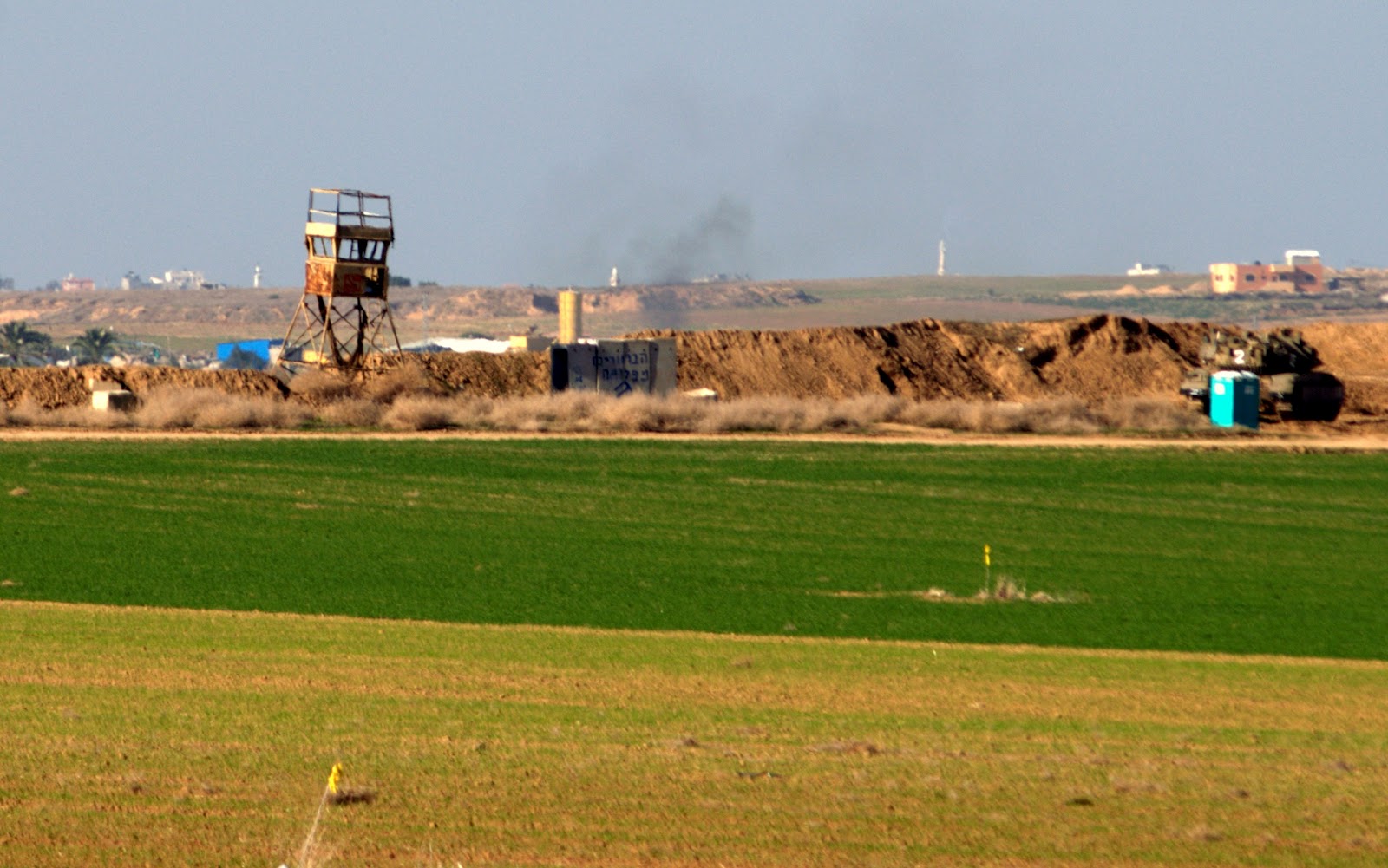
An Israeli army tank, a porta-potty, and an unused lookout tower at a position facing the Gaza Strip across the road from a kibbutz, whose fields are seen in the lower part of the image (Photo: Dave Bender, All Rights Reserved)
Israeli army display of military-grade and homemade IED's used against troops and civilians along
roads and patrol paths adjacent to the Gaza Strip (Photo: Dave Bender: All Rights Reserved)

Sunday, May 3

Day By Day at an Israeli Army Checkpoint

Colleague Joel Leyden writes:
"A grey, blustery sand storm rolls fiercely into Kalandia. The sky turns a dark brown over this Israeli checkpoint bordering Jerusalem and Rahmallah. The dust burns your eyes as you focus on a Palestinian family approaching the cement block which serves as your desk. They wear red and white scarves over their faces, protection from the freezing, relentless winds. They reach for their identity cards, but you know that it could be a gun or a knife. You are half Mr. Nice Guy and half combat soldier. You must be able to go from a warm smile to loading your M-16 in half a second. You are an IDF volunteer who the Palestinians and Israeli soldiers refer to as a Humanitarian Officer."
More posts about the IDF here.

Friday, March 6

Live Video Footage of Jerusalem Terror Attack

This is video footage from Thursday's terror attack in southern Jerusalem, shot from what appears to be a traffic cam across the intersection.

The rest of the story is here.

More on those attacks here, and here.

(H-T: Avi Abelow)

Thursday, March 5

Breaking: 3rd Tractor Terror Attack in Jerusalem

Israel National News has a good slide show of the scene.

Hamas has lauded the attack, according to Haaretz, quoting Reuters:

"Gaza's Hamas rulers praised Thursday's bulldozer attack in Jerusalem as a "natural response" to Israel's demolition of Palestinian homes in Arab East Jerusalem and to Israel's military operations in the Gaza Strip.

"'The operation in Jerusalem was a natural response to aggression against our people. The Zionist enemy should realize that they alone bear the responsibility for displacing our people in Jerusalem and for the killings in Gaza and the West Bank,' said Mushir al-Masri, a senior Hamas official."

From the JPost:

"A Palestinian man driving a bulldozer was shot dead after intentionally attacking a police car on Thursday afternoon. Before he was shot, the man tried to tip over additional vehicles including a public bus at the Golomb intersection, near Jerusalem's Malha Mall.

Police next to the bulldozer...
Police next to the bulldozer used in Thursday's terror attack near Malha, Jerusalem. Photo: Channel 2

"Two police officers were reportedly lightly injured in the attack.

"Less than an hour after the attack, Nissim Shahar, deputy commander of the Jerusalem Police, told Channel 2 that the terrorist had died of his wounds."

Malcha mall, just past the intersection where the attack took place, is one of the largest malls in Israel, and would normally be packed with shoppers at this hour of the afternoon.


From Haaretz:

"This is the fourth time that a vehicle has been used to carry out an attack in the capital. In July 2008, a Palestinian deliberately went on the rampage in a bulldozer on Jaffa Street, killing three people and wounding dozens more. Two weeks later, a resident of East Jerusalem carried out a similar attack, wounding at least 24 people.

"In September, an Arab resident of East Jerusalem plowed his car into a crowd of Israel Defense Forces soldiers on their way to the Western Wall. All three were shot dead at the scene."

More on those attacks here, and here.

Friday, February 13

Gaza: Hamas Turned Aid Meds Into Grenades

From The JPost:

Medicine bottles, transferred to the Gaza Strip as humanitarian aid by Israel, were used by Hamas as grenades against IDF troops during Operation Cast Lead. Pictures of the grenades were obtained exclusively by The Jerusalem Post.

Hamas turned these drug...

Hamas turned these drug containers into weapons.
Photo: Courtesy

The medicine bottles were manufactured by the Jerusalem Pharmaceutical Company, which is based in el-Bireh, a town adjacent to Ramallah, and the global pharmaceutical company Shire.

The medicine bottles were filled with explosives, holes were drilled in the caps, and fuses were installed. Once Hamas fighters lit the fuses, they had several seconds to throw the grenades at soldiers. The IDF also found small explosive devices that used medical syringes to hold their fuses.

The medical grenades were discovered in northern Gaza by troops during last month's three-week battle against Hamas. The grenades were taken to military explosives experts, and then disassembled and studied.

Tuesday, January 6

What Part Of 'Exploiting Hospitals For Cover' Isn't Clear?

Two hard news items that may help in clarifying the question, and providing the answer for the moral cretin audience:

Hamas Officials Hiding in Gaza Hospital Maternity Ward - Avi Issacharoff (Ha'aretz)
Palestinian sources said senior Hamas officials have been spotted more than once wandering around the maternity ward of Gaza City's Shifa Hospital and even using the hospital to hold press conferences, on the theory that it offers a safe haven from Israeli fire.
For the same reason, Hamas forces have taken refuge near buildings that serve as headquarters for various international organizations, such as the Red Cross and the UN.


Hamas Steals Aid Supplies for Its Own Hospital for Gunmen - Yaakov Katz (Jerusalem Post)
Hamas has set up an independent hospital in Gaza to treat its wounded and is pilfering a significant portion of the medicine allowed into the Strip, senior defense officials said Monday.
Nevertheless, the Defense Ministry said it would continue facilitating the transfer of food and medical supplies into Gaza since the humanitarian convoys play a key role in garnering international legitimacy for the IDF's operations.

More here.

Sunday, January 4

How To 'Reach Out And Touch Somebody' In Gaza


How the Israeli Army manages how to know who, where and how to warn non-combatant Palestinians in Gaza when to get the hell off the phone and out of the building before the Hellfires drop, is eerily similar to the movie, "Eagle Eye:"
"[Apparently] the Israeli Army has "figured out how to separate the civilians from the weapons: call the neighbors and give them ten minutes warning.

"Apparently, by Friday Israel had made at least 9,000 (nine thousand) such phone calls.


"The numbers prove how efficient this has been: prior to the ground invasion, more than 600 targets had been destroyed, fewer than 500 Palestinians killed, and fewer than 100 of those were civilians even by Palestinian and UN reckoning."
Also as apparently, this blogger is an IT ubergeek - NOT that there's anything wrong with that. Jus' sayin'.

For the rest'a'us, let's take a deeeep breath, and read the next paragraph together aloud:
"Israel clearly has created a sophisticated GIS (geographic information system). A system that records tens of thousands of buildings, their location, and their distance from each other. Then there's a database with the names of the tens of thousands of families who live in the buildings, and the phone number of each family. The system has the ability to identify all the families and phone numbers that could be affected by an attack on any given building. Finally, given the numbers involved, there must be a system that automatically makes concurrent phone calls to dozens of families, since everybody has to have the same ten-minute warning.

"Ah, and someone put tens of thousands of piece of information into that database.


"Such a system costs real money, takes time to set up, and since it is obviously operating close to flawlessly, it was tested, fiddled with, tested, fiddled with, and tested again. The purpose, I remind you, is to save the lives of thousands of Palestinians who happen to have murderous neighbors.
Ahh, right, that last sentence.

Turns out there's a pretty cool and constructive use for that paranoid, slacker fever-dream of a plot that that pretty much made up Eagle Eye, after all.

Who knew? Clearly not the PatriotActophobics who made the film.

Read the rest
.

Latest Twitters On The Fighting & 'Hamasochism'

Latest Twitters on the Fighting in Gaza & 'Hamasochism'
---
Contrast & Compare:

Exhibit A)
Israeli doctors mobilize to save a Palestinian baby's life: http://tinyurl.com/9ahb2v


More about this here.

Exhibit B)
From Richard Landes:

"Would Hamas secretly blow up its own people in order to blame Israel? Certainly, their ideology would justify such a move. As Hamas representative Fathi Hamad said last February, “Palestinians have created a human shield against the Zionist bombing machine.”

For the Palestinian people, death became an industry, at which women excel and so do all people on this land: the elderly excel, the Jihad fighters excel, and the children excel. Accordingly [Palestinians] created a human shield of women, children, the elderly and the Jihad fighters against the Zionist bombing machine, as if they were saying to the Zionist enemy: We desire death as you desire life. [Al-Aqsa TV (Hamas) Feb. 29, 2008]

"As if to illustrate both the international reach of this Islamic ideology of death and martyrdom and it’s repugnant quality (at least to a Western liberal), a Saudi cameraman filmed live the “making of a martyr” when the doctors pulled the plug on a girl in a Gaza hospital. Could she have lived, had Hamas allowed her to go to Egypt in one of the many unused ambulances waiting at their southern border? We will never know."

'We didn't mean to, but we lied to our kids'

From Daniel Gordis:
"Why should children living in uncontested Israeli territory grow up being taught that in the playground, when the siren goes off, you run into the caterpillar, and hope that the rocket doesn't kill any of your friends who don't make it in time?

"These weeks, with the question of whether or not Jewish sovereignty means anything at all, there is really only one question. As Joshua said to the angel (Joshua 5:13), "are you for us, or for our adversaries?" Do you believe that Jews in Sederot have a right to live without bomb-shelter caterpillars in their playgrounds?

"Do you understand that the only point of having a Jewish state is that Jews should no longer live - and die - at the whim of those who hate us just because we exist?"

And this from Victor David Hanson at NRO:
"There is something especially nauseating about the latest Middle East war — scenes of worldwide Islamic protests with photos of Jews as apes, protesters (in Ft. Lauderdale, Florida of all places!) screaming about nuking Israel and putting Jews in ovens, parades of children dressed up with suicide vests and fake rockets, near constant anti-Semitic vicious sloganeering, Gaza mosques stuffed with rockets to be used against civilians — all to be collated with creepy Hamas rhetoric about the annihilation of Israel. This is the world in which we now live."

Friday, January 2

'Aid2Gaza:' Succinct. Comprehensive. Guess who's the owner?

Aid2Gaza. Succint. Comprehensive. Veddy Brrrritsh. Oh, and you'll never guess who puts it out:
"This is a website, maintained at the Israeli Embassy in London, which aims to give as much information as possible on all the international aid being sent into Gaza.

"We’ll post updates from Israel’s COGAT (Coordination of Government Activities in the Territories) office, OCHA, UNRWA, USAID, ICRC (International Red Cross Red Crescent) and WHO information, as well as individual and group actions from the grassroots ,like the Free Gaza Movement."

And daring. Did I mention daring - aka "Hutzpadik?"

This week in Israel: Margot Dudkevitch on Gaza (Exclusive Podcast Interview)

Thanks and a shoutout to the whole freakin' world that's been clicking on the following link. Umm, here's a heads-up, folks: It's from 2006 - same place, similar situation - and, unfortunately, is a dead audio link. Sorry 'bout that - I'll try to get her on the line soon for an update:

Friday, June 30

This week in Israel: Margot Dudkevitch on Gaza (Exclusive Podcast Interview)


Israeli tank crew viewing an explosion in the Gaza town of of Beit Hanun (archive)

Hear Margot Dudkevitch, an Ozsraeli defense affairs and territories commentator, and former Jerusalem Post territories reporter as she takes look at this difficult week in Israel, the West Bank and Gaza.

Sunday, December 28

Gaza: The real reasons Israel - finally - retaliated (Update 4)


High resolution map of the Gaza area. Click on the image for a close-up view. (University of Texas)

Read this, and then feel free to come back and talk to me about the "disproportionate" Israel response to over 10,000 rockets, mortars and terror incursions that have gone largely under and just plain unreported by the international press for, oh, 'bout the last 7-8 years.

I'm here. Listening. Waiting. I dare you. Really.

Update: Click here for a clear, in-depth audio interview with a British resident of Sderot on the current situation.

Meanwhile: A Twitter Kassam feed.


(Courtesy SderotMedia.com)

Above is a amalgam of video clips showing how Sderot residents (and thousands of other Israelis in rocket range of the Gaza Strip) have been living for the past 7 years.

The interviewer is asking the child about the "fun day" activities in Sderot, when they are interrupted by the town loudspeaker announcing "Color Red," the alert for an incoming rocket attack.

Residents have 15 seconds to reach shelter, before the missile slams down. About the same amount of time it took you to read this far.

The rest that follows should be clear enough.
---


Caption: we're not the State's sitting ducks." Young Sderot residents don red and black armbands in a protest against ongoing Hamas-led Kassam rocket attacks from Gaza against their southern Israeli town in 2006. (File photo: Dave Bender)


Resident of an Israeli farm bordering Gaza looking at a hole blasted in a wall of her house by a Kassam rocket, that killed her son's girlfriend in 2004. (Photo: Dave Bender)


View from the other side of the wall of the shattered room. (Photo: Dave Bender)


Here's what local residents throughout the south of Israel are reading this evening:

Dec 27th, 2008

Israeli Communities within Range of Rocket Fire – Emergency Instructions for Civilian Population

The firing of rockets at Israeli communities surrounding the Gaza Strip is expected to continue over the next few days, and may expand to additional area. Therefore, residents are requested to follow directions for preparing a protected room and act in accordance with the instructions at the sound of an alarm, an explosion, or a "Color Red" alert.

Residents of villages adjacent to the security fence are asked to remain within shelters tomorrow, in close proximity to protected areas, and are requested not to assemble in groups.

All schools and commercial centers will remain closed, with the exception of vital services, such as medical centers, grocery stores and public transit will operate on a limited schedule.

Residents in the rest of the villages within range of up to ten km of the Gaza security fence are directed to ensure that they are no more than fifteen seconds from a protected area. Public gatherings in this perimeter are forbidden.

Residents of towns in the range of ten to twenty kilometers from Gaza , must be able to enter sheltered areas within thirty seconds. This area includes the cities of Ahkelon, Netivot and the surrounding towns. In these towns, gatherings of up to 100 people are allowed to be held only under reinforced ceilings. Commercial activity will only be allowed to take place in reinforced buildings.

Residents of towns in the range of twenty to thirty kilometers from Gaza , must be able to enter sheltered areas within forty-five seconds, and gatherings of up to 500 people are allowed to be held only under reinforced ceilings.. This area includes the cities of Ashdod , Kiryat Gat, Kiryat Mal'achi, Ofakim, Rahat, and the surrounding towns. Educational activity will take place in reinforced buildings only. Commercial activity will only be allowed to take place in reinforced buildings.

A number of important issues for the population:

  • The Home Front command has advised the local authorities to open the public shelters. Entrance to the shelters is advised only if they are reachable within the aforementioned time frames.
  • Gatherings near rocket attack sites should be avoided. Unidentified objects and rockets should not be approached. In such instances the police should be notified.
  • Adhering to these guidelines and entering sheltered rooms - saves lives.
  • Additional information can be obtained via the Home Front Command's hot line 1207 and website: www.oref.org.il.
Just sayin'.

Update:

Listening to the Israeli radio stations through the night there (Saturday night here), I hear, over and over, Israeli songs that are always played when there's a genuine "warlike" situation nationally.

Mostly local hits from the 1960's and 70's, along with a smattering of Europop faves. Nothing "nationalistic," or militaristic mind you, just an accent on songs - many of them pretty odes to a simpler day, that have pretty much served as the soundtrack of Israeli society through war and national crisis. Like American's talking about the "good ole' days" of television around the "national campfire."

Ok - slight update: Army radio (one of Israel's most trusted, iconoclastic and non-propagandaish news outlooks, btw), is playing James Brown's "It's A Man's World." Go figgur.'

No massive message here - feel free to add your own, though.

Wednesday, July 23

Jerusalem: come for the terror -- stay for the culture!

No, really. I mean it:
  • Israelis may have the blues, but they don't play the blues, which is why they have to rely on Americans to do it for them. Get low down in the (Nile?) Delta with the Jerusalem Blues Project tonight at Mike's Place.
  • Shaanan Street, lord and master of chartbusting hip-hop/funk outfit Hadag Nachash, has gone solo for some reason and will be performing live at Beit Avi Chai at 22:30 on Saturday night in support of his just-released album.
  • There's something appealingly incongruous about Hebrew-language stage adaptations of popular American films - and if you need an example, look no further than the Jerusalem Theatre's winning production of Rain Man, also on Saturday night.
  • On Monday, swing by the Musrara art school to admire the works of its talented students at a special class gallery showing, and wind down the evening with cocktails and the smoky vocal stylings of young chanteuse Shelly Tzarafi at Birman.
There's plenty more happening throughout the city, and as always, all you need to do is click over to the Events section to find it. Have a great weekend.

H-T: http://www.jerusalemite.net/blog/

And this is just a few of the, oh, 'bout a thousand reasons why I frikin' love the place. No, really. I'm not kidding.

Tuesday, July 22

2ND TRACTOR TERROR ATTACK IN J'LEM


Tractor at the site of the attack. (Alona Alalaluf/Ynet News)


A tractor driver rammed and flipped over a city bus and several cars in downtown Jerusalem close to 2 pm.

An Israeli civilian, Ya'akov Asael, 56, of the community of Sussiya in the Hebron Hills area, and Border policeman Officer Amal Ghanem shot and killed the attacker, according to Army Radio.

The terror attack took place at the intersection of King David and Keren Hayesod Street, and was a nearly exact copy of a similar attack on July 2.

The intersection is the nexus of three major avenues and the site of three hotels: the Inbal, the King Shlomo, and the nearby King David.

The body of the terrorist lies in the backhoe's cab; bullet holes pepper the window. (Haaretz)


Police say the 22-year-old terrorist managed to drive the backhoe 160 meters (0.09 miles) until he was shot and killed by the two passersby. The spokesman said that police "may change their operational methods in the wake of the attack."

Live footage taken shortly after the attack is here.

Yuval Diskin, who heads Israel's Shabak internal security service said that they had received reports of a planned attack against targets in the city, including the use of a tractor, one hour before the rampage.

Authorities have thrown a gag-order on local reporting of any identifying details of the attacker. The individual was reported to have been working with the tractor, a JCB backhoe at a nearby construction site at the Yemin Moshe cultural and convention center.

Debka.com reports that the driver was "Ghassen Abu Tir from Umm Tuba, a Palestinian village in southeast Jerusalem, who was employed at the building site. He was a relative of Muhammed Abu Tir, a Hamas lawmaker held in an Israeli jail."

Police say they were "familiar" with the assailant, and that he has a criminal record.

Latest reports say 29 people were wounded in the attack, including a mother and her nine-month-old infant, according to Israel Radio. A woman sustained a heart attack, and another individual is in danger of an amputated limb in the attack, according to the spokesperson. The remainder are reported to be suffering from shock.

View Larger Map

Diplomats and VIPS are commonly housed at the Inbal and King David hotels, which are both several dozen yards from the intersection.

Democratic Presidential candidate Barack Obama is due to arrive in Jerusalem Tuesday evening for talks with Israel and Palestinian leaders, and was to be housed at the Inbal. It is unclear what effect the attack will have on his visit.

Liberty Bell park, which is heavily visited by the city's Jewish and Arab residents, and tourists is also across the street from the site of the attack, and Jerusalem's YMCA, a major landmark and cultural facility is nearby.

Police spokesmen say the terrorist copied a a similar attack three weeks ago near the entrance to Jerusalem, in which a Jerusalem Arab resident killed three motorists, and wounded 45.

A city Egged bus on the No. 13 line was rammed in both attacks.

No group has taken responsibility for the latest attack, and police believe the terrorist acted alone as in the previous attack.

The rampage joins a series of other terror attacks throughout the city over the past two months, aimed at it's Jewish residents.

This report will be updated as more details become available.

(Dave Bender)

Monday, June 16

'Israel As The Battered Woman'


(Graphic courtesy of Chabad)

I just came across this prescient article below, penned by American-born therapist Dr. Miriam Adahan, not long after the 1993 Oslo Accords between Israel and the then nascent Palestinian Authority. Around the same period, I worked as a producer and program host at a "micro-broadcast" radio station in Jerusalem, called "RadioWest."

One evening as I was working the control board during the hourly newscast, Dr. Adahan was sitting in the studio alongside the news reader, waiting to begin her call-in show. As I watched the reader tersely recite a day's litany of terrorism and other mayhem, Adahan hid her eyes in her hands, and rocked back and forth in her seat as in grieved shock and mourning. How true her words ring today:
"In years to come, historians will be shocked at how Israeli leaders happily encouraged a gang of Arab murderers to create a country within our tiny borders -- a country which never existed before -- and gave them arms knowing that those arms could be used to kill and maim us, and then continued to try to appease the murderers. Why are we fulfilling Hitler's dream? Why did we ignore Arafat's rhetoric calling for our destruction, ignore the fact that they were flooding their cities with arms, and ignore the warnings that they are preparing for all-out war?"

(...)Want to understand what happened here in Israel? Listen to the battered woman:

1. "It takes two to make a fight. So I must deserve this abuse -- after all, I'm not perfect either. I left dishes in the sink, was talking on the phone when he came home and didn't have dinner ready on time. Sometimes, I was a little confused after he beat me up and didn't function so well. These sins of mine are so enormous that whatever he does is justified. I should have done better, should have known, should have anticipated...." (Israel: "As penance for not being perfect, we must allow them to continue murdering us.")

2. "If he's so angry, it means that I'm to blame. People don't get angry about nothing. It must be that I haven't done enough to please him. If I just try harder, I'm sure I'll eventually win his love." (Israel: "We must keep making more concessions. We're the more enlightened country, so we have to keep trying harder to get them to become more democratic, more humane, more civilized.")

3. "No matter how badly he acts at times, I truly believe that he doesn't really mean to hurt me and that he really does love me underneath it all. He just has to act like this to prove his masculinity. It doesn't really mean anything, because underneath it all, there's a good man." (Israel: "No matter how many of us he kills, Arafat is our partner. The fact that he keeps wanting to talk is proof of his love, isn't it? Otherwise, why would he take the time to talk to us?")

4. "I'm proud of myself for being loyal and determined! I stand by my man through thick and thin. You don't leave during the bad times. When you're willing to forgive after getting beaten up, that's when you prove how strong your love is." (Israel: "We take pride in the fact that we are the ones who care more about peace, and keep negotiating even when we're under attack. Hey world! Look at how much we're willing to suffer and not fight back! Now will you love the Jews?")

Read the rest, and weep.

Tuesday, September 11

Eyewitness to 9/11 in Jerusalem's Old City

Following are a number JPost Radio reports I prepared from Jerusalem's Old City immediately after the terror attacks against the US on 9/11/01:

Me, hoofing it with crash helmet, mike and gear down the darkened alleyways of the "souk." This shot was lit by camera flash. It was much darker, with sounds and footsteps echoing off the cobblestones. (Mati Milstein)


Talking with American tourists (Oklahoma and Arkansas) along the Via Dolorosa. After hearing the news of the attacks, they hurried back to their hospice, en route to a flight back stateside. (Mati Milstein)

I interviewed Muslim and Christian Palestinians, American Christian tourists, and Jewish seminary students from New York.

We made our way north to south, from the Damascus Gate in the Muslim Quarter, through the Christian Quarter to the Jewish Quarter, near the Western Wall Plaza and Temple Mount area in the Old City. We exited the Old City
at Zion Gate, near the Armenian Quarter.


Speaking with a Palestinian shopkeeper at an Internet cafe'. The interviewee is unconnected to the following clips. (Mati Milstein)
  • Palestinian Muslim shopkeeper: Damascus Gate. BTW - that incredulity you might hear in my voice, as I'm talking with this guy? It's real.

  • Second Palestinian Muslim shopkeeper, further down the alleyways, towards the heart of the Old City:

    powered by ODEO
  • Two American tourists hurrying for safety at a Catholic convent where they were staying:

    powered by ODEO
  • Talking with a group of four yeshiva seminary students. They are in a pizza parlor in the Jewish Quarter, watching a television showing images of the smoking WTC towers:

    powered by ODEO
Digg!

Search:

Google
Web Israel At Level Ground